

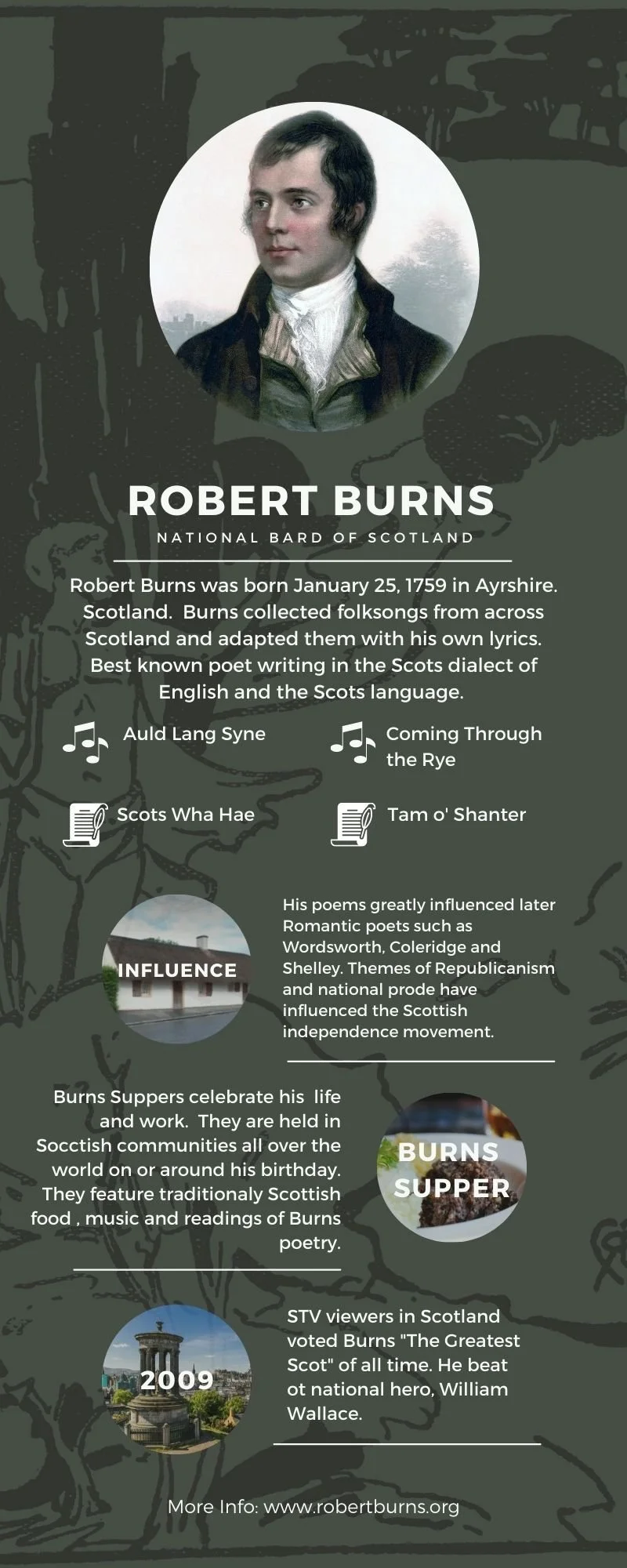
Who was Robert Burns?
Even if you don’t know the name, you’ve heard some of his poetry. He’s the lyricist who gave us “Auld Lang Syne”. He’s the man who wrote the words, “The best laid plans of mice and men…”, and “My love is like a red, red rose…” that have become pervasive in the English-speaking world. That’s an achievement when you consider that much of his poetry was in the Scots language. His words have inspired political movements, musicians, and writers from Samuel Taylor Coleridge and Percy Bysshe Shelley to John Steinbeck and J. D. Salinger. For only living thirty-seven years, Robert Burns’ influence has been felt worldwide for centuries.
For more information including a library of Burn’s poetry, biographical info, and a Scots glossary check out Robert Burns Country: the official Robert Burns site.
Scots language
Before we get into poetry, I should say something about the Scots language. Because one of the most distinctive and revolutionary things about Robert Burns is that he wrote his poetry in the language of the people.
Scots (not to be confused with Scottish Gaelic) is a Germanic language that evolved in Scotland from the language of the Angles who arrived in the Scottish lowlands around 600 CE. Over the centuries the language evolved to become distinct from English as you will hear in some of the poems that we share today. The structure of Scots is very similar to English, however, the vocabulary and spelling can be quite different. Below are some common Scots words and their English counterparts.
Additional Resources

Storytelling – Tam O’ Shanter
“Inspiring bold John Barleycorn!
What dangers thou canst make us scorn!
Wi’ tippenny, we fear nae evil;
Wi’ usquabae, we’ll face the devil!”
Much like the characters in my Once & Future Series, Robert Burns collected folklore from around Scotland. Scottish folklore is awash with cautionary tales about the surprising and often terrifying things that can happen to a person while traveling alone at night. So, when he was asked to contribute something to Francis Grose's Antiquities of Scotland, he adapted a story from his hometown into the narrative poem “Tam o’ Shanter”.
In this poem, Tam, our main character, enjoys himself a little too much at the pub and sets off for home on his horse. But as he nears the abandoned Alloway Kirk, he spots a scene out of nightmares. A host of witches were dancing to the tune of a demon piper. Tam can’t look away, but when he exclaims in surprise, the witches see him and give chase. He escapes only by riding across the River Doon, because according to folklore evil spirits can’t pursue a person across running water.
Traditional Burns Supper
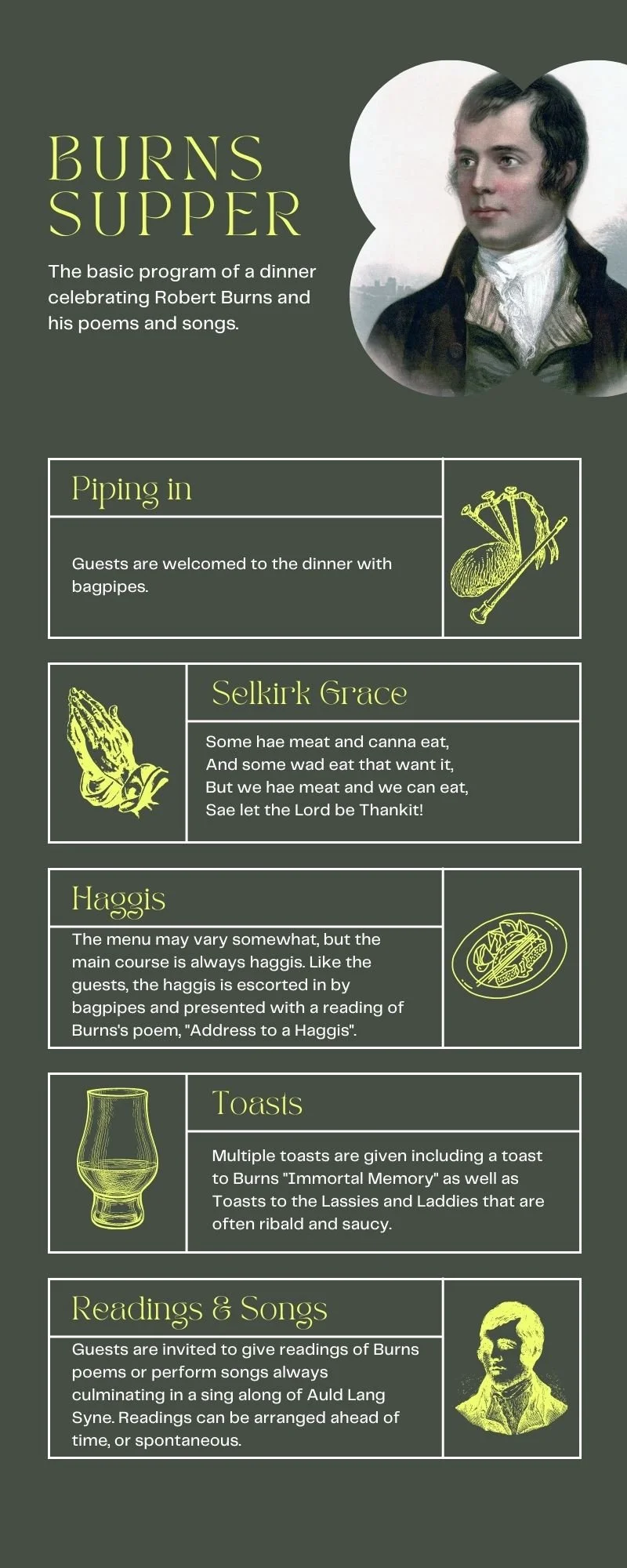
Traditionally, in Scotland and Scottish communities around the world, folks celebrate Robert Burns Day with a Burns Supper. These are also sometimes used as fundraising opportunities for charities. In my book Thrice to Thine, my characters hold a Burns Supper to raise funds for a project to collect folklore around Scotland.
This involves a meal of traditional Scottish foods, especially haggis and ‘neeps and tatties’ (turnips and potatoes). The haggis is usually escorted in with bagpipes and a recitation of the Burns poem, ‘Address to a Haggis’. Burns Suppers also include readings and performances of songs written by Burns, and of course, much toasting.
Traditional Scottish Recipes
Haggis If you don’t want to make your own, I recommend The Scottish Gourmet USA
Here is a book of more traditional Scottish recipes.
Address to a Haggis
After being piped in, but before the ceremonial cutting of the haggis the host or honored guest will deliver the “Address to a Haggis” a poetic tribute to Scotland’s national dish.
Toast to the Lassies & Laddies
Possibly the most fun that will be had all evening. One of the men present will give a toast, usually humorous, sometimes flirty, in appreciation of ladies. This toast can be ribald, but shouldn’t be offensive and should always end with flattery. Sometimes the toasts are in verse and borrow from Burn’s own words. As women began attending Burns Suppers, a responding Toast to the Laddies was added. The tone is usually the same with the object being men. Below are links to a couple of examples.
Immortal Memory
This is the keynote of the toasts at a Burns Supper. It is often educational about the man himself and his career. It should also touch on his influence on later writers and his spirit. Here is an example of an Immortal Memory. You can find mine at the end of this page.
Philosophy– Tae a Louse
Robert Burns was a great believer in the ‘brotherhood of man’, and many of his poems address this theme. Few do it more eloquently than Tae a Louse. In this poem, the poet sees a louse making its way across the bonnet of a finely dressed lady. He goes on to muse about the louse’s indifference to a person’s dress or social status. We are all just potential hosts. He ends with the declaration:
O wad some Power the giftie gie us
To see oursels as ithers see us!
Songs - Ae Fond Kiss
Songs are as much a part of Burns’s legacy as his poems. We’re all familiar with “Auld Lang Syne”. The song “Coming Thro the Rye” plays an important role in J. D. Salinger’s classic novel Catcher in the Rye.
Burns also wrote more than a few love songs and poems. In my book Thrice to Thine, my main character Sarah bonds with her newly found father through the lyrics of “Mally’s Meek, Mally’s Sweet”, a Burns song that mentions her late mother’s name. Another Burns song that inspired me is “Ae Fond Kiss, and Then We Sever” about a pair of star-crossed lovers. I wrote my historical novella, “A Fond Kiss” to tell a mostly true story of ill-fated lovers in nineteenth-century North Carolina.
The song is hauntingly beautiful, especially this rendition by Rachel Sermanni.
Immortal Remembrance
As most Burns Suppers end with an Immortal Memory, I thought I would give you my brief take.
There is so much to talk about with Robert Burns, and I encourage everyone to read more of his poems and more about his life. I think the thing that excites me the most about Burns is that he was truly revolutionary in many ways.
At a time when there were basically two types of poets; those who were academics or dilettantes of the nobility and regular citizen poets who recited poems and sang songs in pubs and by firesides. Burns wasn’t an academic, or a man who could afford to swan about manicured gardens thinking of his next verse. He was the son of a farmer who struggled at farming himself until he found success as an exciseman, a sort of tax collector. Burns bridged the gap between those posh poets and the common ones. He wrote poems about philosophy, and love just like the former, but in the language and illustrated in situations like plowing a field or sitting in church that were accessible to everyone. His poems lay bare the human condition in a way that is familiar to all of us regardless of class or education. As a result, his first volume of poems was an almost instant hit.
His language was also revolutionary. Despite being advised not to by friends and his former tutor, Burns wrote in the Scots language which at that time was considered Provincial and not proper English. They were worried that it would limit the size of his audience, but the exact opposite seems to be true. Born in the aftermath of the Jacobite Rising in 1745, at a time when cultural leaders shunned most things that were uniquely Scottish in favor of finding common ground with the English, Burns’s popularity and use of the Scots language was a reclaiming of Scottish identity. While he wasn’t the first to write in Scots, he was the most popular since 1745 and contributed to a resurgence of national pride.
He also spent time collecting traditional Scottish songs, and folklore. Some he adapted adding his own lyrics to traditional tunes. And he used themes of Scottish folklore throughout his work. This alone was bound to capture my folklore-loving heart, but it also made his work call to a people who were sorely in need of a champion.
He was also politically revolutionary favoring themes of egalitarianism and democracy. Burns wrote poems like “A Man’s a Man for a’ That” railing against classism and “Awa’ Whigs, Awa’ which targeted supporters of the Union with England. Burns wrote about Scottish nationalism in “Scots Wha’ Hae” and railed against slavery in “A Slave’s Lament”. He voiced support for the American and French revolutions, which may have actually hurt his relationship with publishers.
“Fare-thee-weel, thou first and fairest!
Fare-thee-weel, thou best and dearest!
Thine be ilka joy and treasure,
Peace, Enjoyment, Love and Pleasure!
”
For all that he is revered today, Robert Burns was human. As I said, he had a day job and struggled financially. He was maybe too fond of ladies, fathering twelve children with four different women. He had notorious affairs, although by most accounts he did love his wife, Jean. Their last child was born the day of his funeral. Some believe he was too fond of drink, although that is hotly debated. He was a man, ‘for a’ that’.
Thanks for listening to me ramble on today about my favorite poet. I’ll leave you with Burns’s benediction from the last verse of “Ae Fond Kiss”


